





Mittelstandspresse
11.11.2026
Purity bottled
Triple capacity for Portugal's favorite mineral water: Água de Luso invests in a high-efficiency returnable glass line from KHS
Dortmund, 11.11.2026 (PresseBox) - A Portuguese love brand born in nature: Água de Luso has been refreshing Portugal for over 170 years. A new returnable glass line from KHS is now bottling its mineral water – both still and sparkling – three times faster than ever before. The project proved quite an undertaking: the water’s purity was a challenge to the filler – and a terrible storm initially wreaked havoc with the schedule.
Before the town of Luso became famous for its water, it initially earned a name for itself as a spa town. Its thermal spring was first described in 1726, with the locals simply referring to it as Banho. Spa visitors started coming to the town in the middle of the 19th century and liked to take the water back home with them. The bottling and sale of Luso’s precious resource ultimately began in 1894. A little while later, bacteriological analysis confirmed that the water was puríssima or extremely pure.
In the decades that followed, Luso’s mineral water became a national brand. “Água de Luso is now the best-known still mineral water in Portugal. It’s a real love brand,” smiles Pedro Sousa. As support functions manager, he’s responsible for investments and innovation at the Sociedade Central de Cervejas e Bebidas (SCC). The beverage producer is part of HEINEKEN Group and now includes the brand in its portfolio. To ensure Água de Luso continues to meet consumer expectations in the future, SCC has installed a new KHS returnable glass line at its production site in Vacariça.
Future for returnables
It replaces a system that after about 40 years of service has now reached the end of its useful life. The market is also changing: PET is still dominant in Portugal, yet the EU PPWR packaging directive, new national laws and deposit systems are putting pressure on non-returnable plastics. The demand for returnable glass containers is growing. For SCC, their investment was thus a strategic decision to position themselves in the premium segment and promote the circular economy, especially in the important hospitality trade. “Of course nobody goes out jogging with a glass bottle,” laughs Sousa. “Yet there are plenty of other areas of application where glass is a competitive option.” Returnable containers also play a key role when it comes to the company’s sustainability targets. “Our returnable glass bottles have an average of 19 lives for the 1-liter format and 21 lives for the 50 cl format, keeping each bottle in use across multiple cycles.”
One line, several objectives
With its new procurement, SCC is pursuing a number of different objectives. “In tripling the line’s output to 40,000 bottles an hour maximum, we want to generate enough capacity for future growth,” Sousa explains. “We attach particular importance to maximum line efficiency, much lower energy consumption and the lowest possible overall operating costs.”
SCC primarily went for a turnkey line from a single source because all machines are connected in a shared network and follow uniform operating standards. This makes it easier to establish a link to HEINEKEN’s Connected Brewery digitalization program. This collects data from the line using IoT sensors and evaluates this on dashboards. Says Sousa, “on an integrated system, this runs through a single interface. With single machines, this would be a lot more complex.”
Puríssima
The top priority for Água de Luso is always product quality. Its water has an extremely low mineral content of less than 50 milligrams per liter. This lends it an especially gentle, neutral taste – and qualifies it for use in the preparation of baby food. However, this presents the filling technology with something of a challenge: standard fill level probes make use of the product’s electrical conductivity. At around 60 microsiemens per centimeter, in Água de Luso this amount is too low to ensure reliable measurement that requires approximately 250 microsiemens a centimeter. KHS’ modular filler platform provides the solution to this problem. It enables probe fillers like the KHS Innofill Glass DRS to also be configured as a volumetric filler (VF). The product is dosed according to its precisely measured volume instead of by filling height. This allows the filling technology to be flexibly tailored to individual product requirements.
In Vacariça, the rotary machine with its 110 filling valves processes up to 40,000 500-milliliter bottles every hour, plus containers holding one liter and – in the future – 0.25 liters. Both still and carbonated water variants are bottled.
Efficient cleaning
The technical highlight of the line is the KHS Innoclean Cascade-D bottle washer. It sanitizes the bottles returned through the reuse cycle using a 70°C cleaning caustic – and is the only heat consumer in the entire system network. The KHS Innoclean KW crate washer doesn't need its own heater as it uses the residual heat from the washing machine. This results in the new line requiring 50% less thermal energy per container than the old one. On double-end washing machines, the heat exchanger used for heating is usually positioned at a great height in the caustic bath, making access difficult. The straight-tube heat exchanger KHS has placed next to the machine for the first time for this project is much easier to get to, thus facilitating operation and maintenance. One heat exchanger can heat up to three baths of caustic. This separation also makes it easier for SCC to switch from steam to another heating medium at a later stage, such as one produced by regenerative sources like solar heat or a heat pump. The machine operates fully automatically, with the sanitized bottles being fed directly into the clean room.
Acceptance in high season
The planning itself required a lot of careful coordination: while the system was being layouted, the respective production shop was being erected in Vacariça. At the same time, SCC was developing a new beverage crate. The KHS machines had to match both. At the end of January 2026, the weather upset everyone’s plans when winter storm Kristin hit Portugal with full force. “The production shop was finished and the machines were packed on the truck,” remembers Frank Schneidermann, the man who’s been responsible for the Portuguese market at KHS since 2010. “But lots of roads had been destroyed and others had to be closed to heavy goods trucks.”
The delivery was delayed by about six weeks and the installation team was initially recalled. During the further course of the project, some of the lost time was made up. However, commissioning, optimization and acceptance took place during the high season. “For a returnable line, this is tricky, as in the summer the empties are with the customer,” states Sousa. “I thus saw full optimization under these conditions for the very first time.” Despite this, acceptance was successful – during one of the peak sales months of the year! Yet the pressure of time also had a positive aspect to it: KHS training took place under genuine production conditions. “Our operators and KHS’ engineers helped each other out,” claims Sousa. “They forged a real bond.” SCC’s personnel also quickly familiarized themselves with the new line. Smiles Sousa, “the feedback has been extremely positive. Our people are proud to be working with the best technology on the market.”
Mutual trust
After over 30 years of close partnership, KHS and SCC share much more than just a handful of projects. The Vialonga Brewery close to Lisbon has three KHS glass lines and one for kegs up and running. There are also numerous single KHS machines in operation. Local Portuguese engineers manage all services. Schneidermann and Sousa have known each other for around 14 years. “Our partnership is based on mutual trust,” says Sousa. “Even if we sometimes have different opinions, in the end, we always find the best solution for both sides.” Things could continue like this for years to come; in Luso, at any rate, history has shown that the people here generally think in longer periods of time.
For more information go to: https://www.khs.com/en/company/news/press-releases
Why not subscribe to our newsletter so that you don’t miss any of the latest news? https://www.khs.com/en/company/news/khs-competence-web-magazine
Ansprechpartner
Alisa Altrock
+49 251 6255 6123
Zuständigkeitsbereich: PR consultant
Datei-Anlagen:

(3 MB)
1639896.attachment
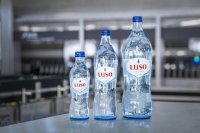
Das stille Mineralwasser von Água de Luso ist in drei Flaschengrößen erhältlich: 250 und 500 Milliliter sowie 1 Liter. / Still mineral water from Água de Luso is available in three different bottle sizes hold-ing 250 and 500 milliliters and one liter.

(4 MB)
1639894.attachment
„Unsere Bediener und die KHS-Techniker haben sich gegenseitig unterstützt. Daraus ist eine echte Bindung entstanden“, sagt Pedro Sousa, Support Functions Manager, Sociedade Central de Cervejas e Bebidas (SCC). / “Our operators and KHS’ engineers helped each other out. They forged a real bond”, says Pedro Sousa, Support functions manager, Sociedade Central de Cervejas e Bebidas (SCC).

(8 MB)
1639891.attachment
Mit der neuen Mehrweg-Glaslinie – hier ein Blick auf das Füllerkarussell des KHS Innofill Glass DRS – hat Água de Luso seine Kapazität verdreifacht. / With its new returnable glass line – here the filler carousel on the KHS Innofill Glass DRS – Água de Luso has tripled its capacity.

(5 MB)
1639890.attachment
Der Kastenwascher KHS Innoclean KW nutzt die Restwärme aus der Reinigungsmaschine und benötigt keine eigene Heizung. / The KHS Innoclean KW crate washer uses residual heat from the washing machine and therefore doesn’t need its own heater.

(4 MB)
1639889.attachment
Technisches Highlight der neuen Mehrweg-Glaslinie von Água de Luso ist die Fla-schenreinigungsmaschine KHS Innoclean Cascade-D. Aus ihr gelangen die sauberen Flaschen direkt in den Reinraum. / The technical highlight of the new returnable glass line for Água de Luso is the KHS Innoclean Cascade-D bottle washing machine. This sends sanitized bottles directly to the clean room.

(149 kB)
1639888.attachment
Key Facts_Água de Luso

(5 MB)
1639892.attachment
Seit 14 Jahren kennen sich Pedro Sousa und KHS Global Key Account Manager Frank Schneidermann (rechts). / Pedro Sousa and KHS global key account manager Frank Schneidermann (right) have known each other for 14 years.

(4 MB)
1639895.attachment
Dank der Reinigungsmaschine KHS Innoclean Cascade-D benötigt die gesamte Linie pro Flasche 50 Prozent weniger Wärmeenergie als die bisherige. / Thanks to the KHS Innoclean Cascade-D bottle washer, the entire line now consumes 50% less thermal energy per container than the old one.
- Mehr Infos zu dieser Meldung unter www.pressebox.de
- zurück zur Übersicht