





Mittelstandspresse
09.11.2026
Deterministic Multi-Camera Vision for Robotics: Design and Integration with AMD Kria
Why synchronized image acquisition, predictable processing latency and adaptable hardware architectures are becoming essential for robotic vision systems.
Fürth, 09.11.2026 (PresseBox) - The Growing Role of Multi-Camera Vision in Robotics
Modern robotic systems are becoming increasingly dependent on visual perception. Autonomous mobile robots (AMRs), automated guided vehicles (AGVs), industrial manipulators and autonomous machines rely on camera-based information to navigate their surroundings, identify objects and interact with their environment.
While a single camera may be sufficient for basic monitoring or inspection tasks, more advanced applications increasingly require multiple image sensors operating simultaneously.
Stereo vision systems use two or more cameras to estimate depth. Mobile robots combine forward-facing, lateral and rear cameras to extend their field of view. Robotic manipulators may integrate both overview cameras and cameras mounted directly on their end effectors.
These configurations introduce an important engineering challenge: acquiring multiple camera streams is relatively straightforward, but processing them consistently, with predictable timing and without compromising system performance, is considerably more demanding.
The challenge is therefore not simply to increase computational performance. It is to establish a reliable vision architecture in which image acquisition, synchronization, preprocessing and downstream processing work together as a coordinated system.
Why Deterministic Processing Matters
For robotic systems, the reliability of visual perception depends not only on image quality, but also on the timing of the information being processed. A mobile robot combining images from multiple cameras, for example, needs to ensure that these images represent the same point in time and that the resulting data is available within a predictable time frame. Unexpected delays or variations in processing time can affect how reliably the robot interprets its surroundings and responds to changes.
This is particularly important when a robot navigates through a dynamic environment and needs to correlate visual information with its own motion and data from other sensors. Variations in exposure timing, transmission delays or processing latency can compromise this correlation and affect the reliability of the resulting perception.
Several architectural requirements become particularly important:
Synchronized image acquisition: Frames from different cameras should have a known temporal relationship, especially for stereo vision, multi-camera fusion and motion analysis.
Predictable processing latency: The time between image acquisition and the availability of processed data should remain sufficiently consistent for the application.
Efficient bandwidth management: Multiple high-resolution video streams place considerable demands on memory and system interfaces.
Scalable preprocessing: Formatting, filtering, conversion and geometric transformations should not unnecessarily burden general-purpose processors.
Reliable system integration: Camera interfaces, processing hardware, software and communication interfaces must work as an integrated system.
Low latency and deterministic latency are not interchangeable. A system may deliver low average latency while exhibiting occasional processing delays. Predictable timing requires controlling variability and ensuring that critical processing steps complete within defined limits.
The Architectural Advantage of Adaptive Computing
Traditional CPU-based vision architectures typically acquire image data through peripheral interfaces, transfer it into system memory and execute processing operations in software. As camera counts and processing complexity increase, CPU utilization, memory bandwidth and scheduling variability can become limiting factors.
FPGA-based architectures offer a complementary approach. Selected operations can be implemented directly in programmable logic, allowing camera streams to be handled concurrently through dedicated processing pipelines.
Parallel processing: Independent camera streams and processing functions can operate concurrently.
Streaming data paths: Processing data as it arrives can reduce intermediate memory transfers.
Timing control: Hardware-controlled acquisition and processing support well-defined timing relationships.
Architectural adaptability: Programmable logic can be modified as system requirements evolve.
Deterministic behavior does not emerge automatically from using an FPGA. It requires appropriate timing design and verification across the complete acquisition and processing chain.
Combining Programmable Logic and Embedded Processing with AMD KriaTM
The AMD KriaTM K26 System-on-Module combines Arm processing cores, programmable logic and integrated video-processing capabilities. Based on AMD Zynq UltraScale+ MPSoC technology, it allows functions to be allocated to the resources best suited to their requirements.
System function
Camera acquisition and timing
Image formatting and preprocessing
System configuration and control
Video encoding
Advanced perception and AI inference
Architectural approach
Dedicated interfaces and hardware-controlled processing
FPGA-based streaming pipelines
Embedded Arm processors
Integrated video codec, where supported
Application-specific software or dedicated acceleration
This separation enables time-critical data-path functions to be implemented in hardware while maintaining software flexibility for higher-level functionality. Actual performance depends on selected camera interfaces, pipeline implementation, data transfers and application workload.
From Architecture to Implementation: The Solectrix SXVPU
A practical example of this architectural approach is the Solectrix SXVPU (Smart eXtensible Vision Processing Unit), an embedded vision platform based on the AMD Kria™ K26 System-on-Module.
The platform brings together adaptable processing hardware and camera-oriented system integration. Its architecture offers a foundation for integrating image acquisition, preprocessing, video streaming and application-specific perception functions into an embedded system. Specifically, it supports the connection of up to four GMSL2 cameras and enables parallel processing of four video streams, providing a compact and flexible vision architecture for robotic systems that require multi-camera perception and real-time environmental awareness.
A relevant design principle is the separation of time-critical image handling from computationally intensive application-level processing. Image-processing functions can be allocated to AMD programmable logic, while embedded processors manage configuration, communication and software-based applications. Additional AI acceleration can be incorporated where required by a specific use case. Its latency-optimized streaming path achieves processing times of less than 10 milliseconds, supporting real-time perception and safety-related applications.
This heterogeneous approach gives engineers flexibility in partitioning the vision workload. For deployment in industrial environments, mechanical integration, power management, thermal design and software reliability remain equally important.
The SXVPU is presented here as an architecture example; the availability and performance of specific synchronization, interface and processing functions must be confirmed for each implementation.
Three Key Design Considerations for Robotics Developers
1. Where Should Synchronization Take Place?
Accurate synchronization should be considered at the acquisition level rather than introduced only after images reach application software. Depending on the sensor architecture, this may involve common triggering, synchronized sensor operation or hardware timestamps. Frame arrival time and exposure time are not necessarily identical; accuracy must be derived from application requirements.
2. Which Functions Require Deterministic Hardware Processing?
Not every image-processing function benefits equally from FPGA acceleration. Highly parallel, repetitive or timing-sensitive operations are strong candidates for hardware pipelines. Higher-level application logic and less time-critical tasks may be better suited to software. Efficient partitioning matters more than maximizing programmable-logic utilization.
3. How Should the Complete Pipeline Be Validated?
Performance should be measured from sensor exposure or frame acquisition to the point where the application consumes the resulting data. Important measurements include synchronization accuracy, processing latency, jitter, bandwidth use and dropped frames, under representative multi-camera workloads.
Building the Foundation for Intelligent Robotic Vision
As robotic systems become more autonomous, vision architectures must support more sensors, increasingly sophisticated perception algorithms and tighter timing requirements. The challenge extends beyond raw computational performance: reliable systems depend on coordinated image acquisition, synchronization, processing and integration.
Adaptive computing provides a foundation for these requirements by combining programmable hardware data paths with embedded software processing. AMD KriaTM K26 and application-oriented platforms such as the Solectrix SXVPU illustrate how this approach can support industrial embedded vision development.
Successful robotic vision systems are defined not solely by how quickly they process images, but by how reliably they deliver the right visual information at the right time.
Achieving this requires the coordinated integration of camera interfaces, synchronization mechanisms, hardware-accelerated image processing and embedded software. Solectrix's work with platforms such as AMD KriaTM illustrates how these elements can be combined in application-specific embedded vision architectures. Key engineering aspects include camera integration, FPGA-based processing pipeline development, software integration and the adaptation of the overall system to the requirements of the target application.
Ultimately, deterministic multi-camera vision in robotics relies on the coordinated design of the entire image-processing pipeline, combining synchronized image acquisition, hardware-accelerated parallel processing and predictable end-to-end latency to meet the timing requirements of robotic perception systems.
About Solectrix
Solectrix GmbH develops customized embedded electronics and intelligent vision systems, combining hardware, FPGA, embedded software and system integration expertise from concept through industrialization and series production.
Further Information
Solectrix SXVPU: https://solectrix.de/produkte/sxvpu/
AMD KriaTM K26: https://www.amd.com/en/products/system-on-modules/kria/k26.html
Ansprechpartner
Franziska Hartlieb-Beutemann
Datei-Anlagen:

(8 MB)
1639191.attachment
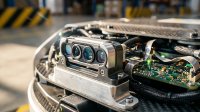
Deterministic Multi-Camera Vision for Robotics (Bild KI-generiert)
- Mehr Infos zu dieser Meldung unter www.pressebox.de
- zurück zur Übersicht