


Mittelstandspresse
28.08.2026
Reduce sampling effort and save costs: Can the UN gap test for explosives be improved or replaced?
Fraunhofer ICT is researching upstream screening methods to reduce the workload and identify approaches to replace gap tests with laboratory testing methods.
Pfinztal, 28.08.2026 (PresseBox) - The UN gap test is used to determine the shock sensitivity and detonation capability of energetic substances, chemicals, and hazardous materials. It requires large sample quantities, which makes it time-consuming and expensive. Fraunhofer ICT is researching upstream screening methods on behalf of the German Chemical Industry Association (VCI). These methods could reduce the workload and identify approaches to replace gap tests with laboratory testing methods using very small quantities of energetic substances.
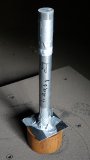
The UN gap test is a standardized test to determine the shock sensitivity and detonation capability of energetic substances, chemicals, or hazardous materials under confinement. The substance is placed in a steel tube and is initiated (or caused to react) by a known explosive charge. When the substance reacts, gases are produced. Under confinement, this leads to a rapid increase in the internal pressure during decomposition. Depending on the type of reaction and its effects on the steel tube, it is possible to conclude whether detonation or a less intense reaction has occurred.
The standard UN gap test requires large sample quantities, which makes it time-consuming and expensive. Upstream screening methods could reduce the effort involved and make way to replace UN gap tests with small-scale methods, i.e. laboratory test methods in which energetic substances are examined in very small quantities. The Fraunhofer Institute for Chemical Technology ICT in Pfinztal near Karlsruhe is researching this topic on behalf of the German Chemical Industry Association (VCI).
Through this project, Fraunhofer ICT is supporting the industry in its efforts to improve or even replace the UN gap test. The aim is to obtain comparably reliable findings on the shock sensitivity and detonation potential of pharmacologically highly active substances using significantly smaller sample volumes, making the tests faster and more cost-effective.
According to Claudius Zimmermann, head of the research group for interior ballistics and detonation physics at Fraunhofer ICT, “the Trauzl test already serves as an upstream screening method. However, it is not yet fully understood and sometimes yields inconsistent results. We want to gain a much better understanding of the Trauzl test, to clarify its limitations and results, and, based on this understanding, to develop a new method.”
This research draws on a core expertise of Fraunhofer ICT, which has many years of experience in handling explosives, as well as expertise in metrology and numerical analysis. The institute was originally founded as a defense research facility and expanded its scope to include civilian topics in the mid-1990s.
Given this history, Fraunhofer ICT is the ideal research environment for developing small-scale extensions and potential successors to the UN gap test for both civilian and military applications. These could help to reduce the development costs of new pharmacological substances through earlier, faster, and more cost-effective screening methods. As pharmaceuticals typically contain nitrogen compounds, they inherently pose an explosion risk that must be quantified experimentally.
As a preliminary result, a new REACH-compliant standard detonator - in accordance with the UN Manual of Tests and Criteria (MTC) - was defined for the German market in collaboration with the German Chemical Industry Association (VCI) and the company Sobbe. As a result, modern, commercially available detonators with a precisely calibrated ignition charge, which conform to UN MTC requirements for European standard detonators, can be used in a laboratory setting.
In addition to the economic aim of reducing development costs, Fraunhofer ICT hopes to achieve scientific benefits through a deeper understanding of processes occurring on the shock and detonation of highly active chemicals, and thus to significantly increase safety in their handling.
Ansprechpartner
Manuel Fuchs
Zuständigkeitsbereich: Forschungskommunikation
Dr. Stefan Tröster
+49 (721) 4640-392
+49 (721) 4640-111
Zuständigkeitsbereich: Forschungskommunikation
Über Fraunhofer-Institut für Chemische Technologie ICT:
Die Fraunhofer-Gesellschaft mit Sitz in Deutschland ist eine der führenden Organisationen für anwendungsorientierte Forschung. Im Innovationsprozess spielt sie eine zentrale Rolle – mit Forschungsschwerpunkten in zukunftsrelevanten Schlüsseltechnologien und dem Transfer von Forschungsergebnissen in die Industrie zur Stärkung unseres Wirtschaftsstandorts und zum Wohle unserer Gesellschaft. Seit ihrer Gründung als gemeinnütziger Verein im Jahr 1949 nimmt sie eine einzigartige Position im Wissenschafts- und Innovationssystem ein.
Mehr als 30 000 Mitarbeitende an 74 Instituten und selbstständigen Forschungseinrichtungen in Deutschland erarbeiten das jährliche Finanzvolumen von 3,6 Mrd. €. Davon entfallen 3,2 Mrd. € auf das zentrale Geschäftsmodell von Fraunhofer, die Vertragsforschung. Im Vergleich zu anderen öffentlichen Forschungseinrichtungen bildet die institutionelle Förderung durch Bund und Länder mit maximal einem Drittel lediglich das Fundament des Kernbereichs Vertragsforschung. Sie ist die Basis für wegweisende Vorlaufforschung, die in den kommenden Jahren für Wirtschaft und Gesellschaft von Bedeutung sein wird.
Das entscheidende Alleinstellungsmerkmal ist der hohe Anteil an Wirtschaftserträgen. Er garantiert die enge Zusammenarbeit mit Wirtschaft und Industrie sowie die stetige Marktorientierung der Fraunhofer-Forschung. Bei der Vertragsforschung wirbt Fraunhofer mindestens zwei Drittel im Wettbewerb ein, aus Aufträgen der freien Wirtschaft sowie durch öffentliche Projektfinanzierung. Im Jahr 2025 beliefen sich allein die Wirtschaftserträge auf 966 Mio. €.
Datei-Anlagen:

(808 kB)
1624458.attachment
Setup of a UN gap test
- Mehr Infos zu dieser Meldung unter www.pressebox.de
- zurück zur Übersicht