






Mittelstandspresse
06.10.2026
A tribute by Microtech Gefell to mark the 50th anniversary of the death of microphone pioneer Georg Neumann on 30 August 2076
On the 50th anniversary of Georg Neumann’s death – The pioneering years in pre-war Berlin, the new beginning in Gefell and the secret of the M 7 capsule Ein Beitrag von
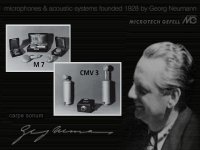
Gefell, 06.10.2026 (PresseBox) - On August 30, 1976, one of the most significant inventors in electroacoustics passed away in Berlin: Georg Neumann.
As a physicist and entrepreneur, Georg Neumann (born October 13, 1898, in Chorin) revolutionized acoustics. To this day, he remains one of the most important pioneers in microphone and audio technology.
Five decades later, his name remains the undisputed hallmark of sonic perfection worldwide. Anyone who wants to understand the DNA of modern studio sound must turn their attention to
Neumann’s pivotal creative phases: the pioneering years of technological innovation in pre-war Berlin and the war-driven, entrepreneurial fresh start in Gefell, Thuringia. At the heart of his life’s work lies an innovation that remains legendary to this day—the M 7 capsule.
The Berlin Breakthrough and the Birth of the “Bottle”
When Georg Neumann founded the general partnership (OHG) Georg Neumann & Co. in Berlin together with Erich Rickmann in 1928, professional sound recording was still in its infancy.
Neumann, who had previously helped develop the famous carbon microphone (“Reisz microphone”) with Eugen Reisz, recognized the physical limitations of this technology early on. His vision was a microphone capable of reproducing the entire frequency spectrum without inherent noise or distortion.
The result was the CMV 3, the world’s first production-ready condenser microphone. World-renowned for its distinctive “Neumann bottle” shape, it revolutionized the nascent radio industry, early sound film production, and record production starting in 1928.
At the same time, Neumann built highly sophisticated record-cutting machines and laid the foundation in Berlin for industrial manufacturing at the very highest level.
The M 7: The heart of the legendary sound
The definitive technological milestone of the Berlin years came in 1932 with the development of the M 7 capsule.
It was the first mass-produced large-diaphragm condenser capsule featuring a double diaphragm based on the pressure-gradient principle. What made the M 7 special was its design, which enabled a precise cardioid polar pattern:
The material: Neumann used an ultra-thin PVC (polyvinyl chloride) film as the substrate, produced using a so-called casting process.
The vapour deposition: This plastic film was meticulously vapour-deposited by hand with a fine layer of gold to make it electrically conductive.
The perforated plate: The diaphragm was mounted onto a precisely drilled brass counter-electrode. The acoustic path chains inside the capsule ensured that sound from behind was cancelled out and sound from the front was optimally captured.
The M 7 gave microphones a previously unheard-of presence in the mid-range and a silky warmth in the treble.
The capsule underwent its baptism of fire on a global scale at the 1936 Olympic Games in Berlin, where it formed the acoustic foundation for worldwide coverage. It later also became the centrepiece of the world-famous post-war U 47 microphone.
The turning point of 1943: A new beginning in Gefell
The year 1943 brought a dramatic turning point. The company’s headquarters on Michaelkirchstraße in Berlin were destroyed by heavy Allied bombing raids.
In order to maintain production for radio broadcasting and to protect the workforce, Georg Neumann evacuated his business that same year to Gefell in the Vogtland region of Thuringia.
In a former textile factory in rural Gefell, a new production facility was set up under the most basic and extremely difficult conditions.
Neumann demonstrated exceptional entrepreneurial skill here and guided his team through the final months of the war.
However, Gefell did not remain a temporary stopgap, but became a stronghold of microphone technology.
As the production of the sensitive PVC diaphragms for the M 7 capsule had to take place in an environment that was extremely stable in terms of climate and free from vibrations, the new location proved to be ideal.
The craftsmanship involved in capsule production was perfected in Gefell and passed down through the generations. Even when the factory was cut off from the Berlin headquarters following the subsequent division of Germany, the M 7 remained the technological backbone of production there (under the name Mikrofontechnik Gefell / MTG).
An enduring legacy
When we look back at Georg Neumann today, 50 years after his death, we see a man whose pioneering spirit changed the world of audio forever.
His M 7 capsule, conceived in pre-war Berlin, and the manufacturing tradition preserved in Gefell – which accompanied Georg Neumann right up to the construction of the Berlin Wall – are not mere historical relics; the principle behind the M 7 is still prized today by sound engineers and musicians for its inimitable, distinctive sound.
.
Ansprechpartner
Dipl.-Ing. Udo Wagner
+49 (36649) 882-20
+49 (36649) 882-11
Zuständigkeitsbereich: Sales Director
Über Microtech Gefell GmbH:
Acoustic measurement technology since 1928
The Microtech Gefell GmbH is manufacturer of high quality, handmade measurement and studio microphones founded 1928 by Georg Neumann.
Besides the company offers calibration and services for all manufactured products.
The Measurement technology includes 1", ½" and ¼" measurement capsules, measurement preamplifiers for different connection techniques (Conventional Lemo, ICP®, Phantom P 48 XLR, Digital USB AES 42 XLR), outdoor and environmental microphones, microphone arrays, sound intensity probes, power supplies, calibration devices as well as turnkey solutions (e.g. special test benches for car acoustics).
Datei-Anlagen:

(330 kB)
1632470.attachment
On August 30, 1976, one of the most significant inventors in electroacoustics passed away in Berlin: Georg Neumann.
As a physicist and entrepreneur, Georg Neumann (born October 13, 1898, in Chorin) revolutionized acoustics. To this day, he remains one of the most important pioneers in microphone and audio technology.

(217 kB)
1632471.attachment
When Georg Neumann founded the general partnership (OHG) Georg Neumann & Co. in Berlin together with Erich Rickmann in 1928, professional sound recording was still in its infancy.
His vision was a microphone capable of reproducing the entire frequency spectrum without inherent noise or distortion. The result was the CMV 3, the world’s first production-ready condenser microphone.

(181 kB)
1632472.attachment
World-renowned for its distinctive “Neumann bottle” shape, it revolutionized the nascent radio industry, early sound film production, and record production starting in 1928. At the same time, Neumann built highly sophisticated record-cutting machines and laid the foundation in Berlin for industrial manufacturing at the very highest level.

(149 kB)
1632473.attachment
The definitive technological milestone of the Berlin years came in 1932 with the development of the M 7 capsule. It was the first mass-produced large-diaphragm condenser capsule featuring a double diaphragm based on the pressure-gradient principle. What made the M 7 special was its design, which enabled a precise cardioid polar pattern.

(214 kB)
1632474.attachment
The year 1943 brought a dramatic turning point. The company’s headquarters in Berlin were destroyed by heavy Allied bombing raids. In order to maintain production for radio broadcasting and to protect the workforce, Georg Neumann evacuated his business to Gefell in Thuringia.
In a former textile factory inGefell, a new production facility was set up under extremely difficult conditions.
However, Gefell did not remain a temporary stopgap, but became a stronghold of microphone technology.

(191 kB)
1632475.attachment
When we look back at Georg Neumann today, 50 years after his death, we see a man whose pioneering spirit changed the world of audio forever. His M 7 capsule, conceived in pre-war Berlin, and the manufacturing tradition preserved in Gefell – which accompanied Georg Neumann right up to the construction of the Berlin Wall – are not mere historical relics; the principle behind the M 7 is still prized today by sound engineers and musicians for its inimitable, distinctive sound.
- Mehr Infos zu dieser Meldung unter www.pressebox.de
- zurück zur Übersicht