





Mittelstandspresse
09.06.2026
Arnold NextG Blogspot: From Vehicle to Operations
Why System Responsibility Is Key to Scaling Autonomous Mobility in Public Transport
Pfronstetten-Aichelau, 09.06.2026 (PresseBox) - Autonomous mobility is often discussed as a technological issue. Sensors, software, and driving functions are at the center of many debates. However, another dimension is crucial for the successful transition from pilot project to regular operation: the organization of responsibility. This is because autonomous vehicles do not operate in isolation—they become part of a system that must be monitored, operated, maintained, and controlled.
As automation increases, the focus of the mobility industry is shifting. While the technical performance of autonomous systems is the primary focus in early development phases, other questions come to the fore during later operations: Who monitors the system? Who intervenes in the event of malfunctions? Who is responsible for availability and operational safety? And how are the control center, technical supervision, service, and fleet management organized?
This is precisely where the consideration of the individual vehicle ends and the consideration of the overall system begins. The German government explicitly identifies this challenge. In its strategy for autonomous driving, it points out that scalable operator and business models for autonomous shuttle services are currently still lacking. This is not solely a matter of economic issues. It is about the ability to integrate autonomous mobility into existing transportation structures in a sustainable and reliable manner.
From Vehicle to Mobility Service
An autonomous vehicle can function technically and yet still fail to constitute a robust mobility service. A public service only emerges when operations are organized, responsibilities are defined, and availability can be ensured on a long-term basis. Vehicles must be accessible, maintainable, and monitorable. Malfunctions must be managed, and responsibilities clearly defined. Only then does a technical demonstration evolve into a reliable mobility service.
The “Handbook on Autonomous Driving in Public Transport” therefore explicitly describes autonomous mobility as an integrated system task. Vehicle technology, technical supervision, operations, and organizational processes must be considered and developed together. With the transition to regular operation, the role of technology also changes. Where today a driver directly manages many situations, autonomous systems must in the future be based on clearly defined roles, responsibilities, and intervention logic. Technical supervision, control centers, teleoperation, service, and maintenance will become integral components of the operational architecture.
Control Enables Operation
At the same time, it becomes clear: This form of system responsibility can only be organized sustainably if the underlying vehicle control system itself is designed to be system-compatible. Control centers, technical supervision, or teleoperation concepts can only be based on systems whose behavior remains reproducible, traceable, and controllable. This creates a direct link between operation and architecture. Control becomes not only a technical function of a vehicle, but a prerequisite for organized operation.
In public transit, this is a matter of practical implementation under real-world conditions. Availability, shift logic, incident management, maintenance processes, and intervention options must be organized in a resilient manner. It is precisely here that it becomes clear whether autonomous mobility will actually become part of regular operations or remain permanently limited to a project-based nature.
Responsibility is being reorganized
Internationally, the same shift in perspective is evident. In its national strategy, France explicitly refers not only to automated vehicles but to “automated vehicles and mobility services.” This shifts the focus away from the individual vehicle and toward the organization of the entire mobility service. Autonomous mobility does not simply replace human labor; it changes its role. A single driver’s workstation evolves into an interplay of technical supervision, a control center, fleet management, service, maintenance, and intervention. Responsibility does not disappear—it is redistributed.
The handbook also makes it clear that personnel and organizational structures must be considered early on if autonomous mobility is to be successfully transitioned into regular operation.
For developers, OEMs, Tier 1 suppliers, and operators, this has a clear implication: The scaling of autonomous mobility is not determined solely by the performance of individual vehicles. It is determined by the ability to make responsibility technically and organizationally manageable. This is precisely why controllable vehicle movement is becoming the central foundation of future operating models. Control centers, technical supervision, and teleoperation can only function efficiently if the underlying systems are designed to be consistent, reproducible, and fail-operational.
With NX NextMotion, Arnold NextG addresses precisely this challenge. The platform treats vehicle control as an independent, fail-operational system layer—as the foundation for technical supervision, teleoperation, and scalable operating models for autonomous mobility.
Conclusion
Autonomous mobility is not decided solely within the vehicle. It is decided where responsibility is organized, operations are secured, and control can be permanently guaranteed. Anyone who wants to scale autonomous mobility must therefore do more than just automate vehicles. They must consider system responsibility from the very beginning.
Autonomous mobility needs more than just smart vehicles. It needs systems that make movement controllable at all times—in the vehicle, at the control center, and in operations. Because only when control becomes technically and organizationally manageable does automation give rise to a resilient mobility system. With NX NextMotion, Arnold NextG is developing a fail-operational system layer designed for precisely this form of scalable vehicle control.
We Control What Moves.
more information, www.arnoldnextg.com/blog
Ansprechpartner
Anke Leuschke
Zuständigkeitsbereich: Pressesprecherin
Über Arnold NextG GmbH:
Über Arnold NextG:
Arnold NextG realisiert die Safety-by-Wire®-Technologie von morgen: das mehrfach redundante Zentralsteuergerät NX NextMotion ermöglicht eine ausfallsichere und individuelle Implementierung, fahrzeugplattform-unabhängig und weltweit einzigartig. Mit dem System können autonome Fahrzeugkonzepte sicher und nach den neuesten Hard- und Software- sowie Sicherheitsstandards umgesetzt werden, ebenso wie Remote-, Teleoperation- oder Platooning- Lösungen Als unabhängiger Vorausentwickler, Inkubator und Systemlieferant übernimmt Arnold NextG die Planung und Umsetzung – von der Vision bis zur Straßenzulassung. Mit der Straßenzulassung von NX NextMotion setzen wir den globalen Drive-by-Wire-Standard. www.arnoldnextg.de
About Arnold NextG:
Arnold NextG realizes the safety-by-wire® technology of tomorrow: The multi-redundant central control unit NX NextMotion enables a fail-safe and individual implementation, independent of the vehicle platform and unique worldwide. The system can be used to safely implement autonomous vehicle concepts in accordance with the latest hardware, software and safety standards, as well as remote control, teleoperation or platooning solutions. As an independent pre-developer, incubator and system supplier, Arnold NextG takes care of planning and implementation - from vision to road approval. With the road approval of NX NextMotion, we are setting the global drive-by-wire standard. www.arnoldnextg.com
Datei-Anlagen:

(2 MB)
1611359.attachment
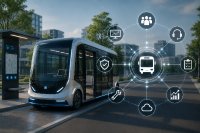
Autonomous mobility is not created in the vehicle alone. Only the interaction of control centers, technical supervision, fleet management, and vehicle control enables scalable operations.
- Mehr Infos zu dieser Meldung unter www.pressebox.de
- zurück zur Übersicht