





Mittelstandspresse
01.03.2026
CypSec Unifies Compliance Framework with Clear Ownership Architecture
Structured responsibility model assigns compliance control code to management, policy verification and enforcement to administrators, and development operations to employees
Heidelberg, Germany, 01.03.2026 (PresseBox) - CypSec today announced the structural unification of its compliance framework through implementation of a clear ownership architecture that assigns distinct responsibilities across management, administrative, and operational domains. The model addresses a systemic failure in conventional compliance implementations: ambiguous accountability where policies exist as documents without defined ownership, enforcement lacks designated responsibility, and verification operates without clear mandate.
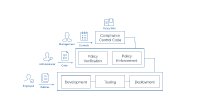
The CypSec framework establishes three primary responsibility domains, each with defined ownership, operational scope, and accountability metrics. This structural clarity ensures that compliance transcends paper exercises to become operational reality with traceable accountability at every stage.
1. Compliance Control Code: Management Ownership
Senior leadership and compliance officers own the compliance control code, the strategic layer defining organizational risk appetite, regulatory scope, and control objectives. This ownership encompasses selection of applicable frameworks (ISO 27001, SOC 2, NIST CSF, regional regulations), definition of control objectives aligned to business strategy, resource allocation for compliance implementation, and acceptance of residual risk where full control implementation proves infeasible. Management accountability manifests in board-level reporting, regulatory attestation, and audit committee presentations where control effectiveness is assessed against strategic objectives.
2. Policy Verification and Enforcement: Administrative Ownership
Security administrators and compliance officers own policy verification and enforcement, the operational layer translating strategic control objectives into technical implementation and continuous validation. This ownership encompasses technical control configuration, monitoring rule definition, enforcement mechanism deployment, and effectiveness measurement. Administrators operate the machinery of compliance: SIEM correlation rules, access control configurations, encryption enforcement, logging and retention systems.
Verification ownership ensures that controls operate as intended, not merely that they exist. Administrators conduct continuous technical validation, such as automated control testing, configuration drift detection and exception monitoring, and report verification status upward to management and outward to auditors. Enforcement ownership includes graduated response definition: automated blocking, escalated review, management notification, exception documentation.
3. Policy Development, Deployment and Testing: Employee Ownership
Operational employees, like developers, engineers and analysts, own the policy development, deployment and testing within their operational domains. This ownership recognizes that effective compliance requires operational expertise: developers understand secure coding requirements for their technology stacks, engineers know infrastructure hardening appropriate to their environments, analysts grasp data handling procedures relevant to their workflows.
Employee ownership encompasses policy implementation within operational contexts, such as secure development lifecycle integration, infrastructure-as-code compliance embedding and operational procedure documentation, and continuous improvement through operational feedback. Employees identify control friction points, propose efficiency improvements, and validate policy practicality through daily execution. This operational ownership transforms compliance from imposed burden to professional responsibility.
The unified framework integrates these ownership domains through structured interfaces. Management control code provides strategic boundaries within which administrative enforcement and employee implementation operate. Administrative verification feeds status upward to management for strategic adjustment and downward to employees for operational correction. Employee operational feedback informs management of control practicality and administrators of enforcement refinement requirements.
For international customers, the ownership architecture delivers measurable governance improvement. Regulatory examinations proceed efficiently with clear accountability demonstration. Internal disputes regarding compliance responsibility resolve through structured ownership definitions. Compliance investments optimize through clear understanding of which organizational functions require strengthening. Most significantly, compliance culture transforms from ambiguous shared responsibility to clear individual ownership, establishing that compliance effectiveness depends on specific persons performing defined functions, not diffuse organizational intention.
Ansprechpartner
Daria Fediay
+31653169442
Zuständigkeitsbereich: Chief Executive Officer
Über CypSec Group:
CypSec is an international cybersecurity company providing integrated compliance and governance solutions for government, defense, critical infrastructure, and enterprise clients worldwide.
Datei-Anlagen:

(373 kB)
1593633.attachment
CypSec Compliance Framework Ownership Structure: Unified architecture displaying management control code ownership at strategic level, administrative policy verification and enforcement at operational level, and employee policy development and testing at implementation level, with structured interfaces and accountability flows connecting all responsibility domains.
- Mehr Infos zu dieser Meldung unter www.pressebox.de
- zurück zur Übersicht