




Mittelstandspresse
24.12.2025
2026 Global Wall Decor Market Report: Technology Shifts, Demand Dynamics & Investment Outlook
The wall décor market is experiencing steady growth, driven by rising home renovation activity, evolving interior design trends, and increasing consumer spending on personalized living spaces.
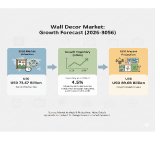
Newark,, 24.12.2025 (PresseBox) - The global wall decor market continues to demonstrate resilient expansion as consumers increasingly prioritize interior aesthetics across residential and commercial environments. Valued at USD 73.67 billion in 2026, the market is projected to reach USD 89.03 billion by 2036, advancing at a CAGR of 4.5% over the forecast period. Wall decor has evolved from a finishing accent into a central design element that reflects personal taste, lifestyle preferences, and brand identity.
Growth remains structurally sound as homeowners, businesses, and hospitality operators invest in visual upgrades that enhance ambience without major structural renovation. Framed artwork, mirrors, murals, wall panels, and decals are widely favored for their ease of installation, affordability, and immediate visual impact. Residential buyers lean toward framed prints and decorative mirrors, while offices, hotels, and retail spaces increasingly adopt murals and textured wall panels to create immersive environments.
Get Exclusive Access To Data Tables, Market Sizing Dashboards, And Analyst Insights. Request Sample Report!
Home renovation and remodeling activity remains a primary demand driver, especially in urban housing markets where space optimization and interior upgrades are prioritized over new construction. Social media influence and digital inspiration platforms further accelerate replacement cycles, encouraging frequent refreshes in wall aesthetics. As personalization becomes central to interior design decisions, wall decor continues to benefit from strong emotional and functional relevance.
Retail dynamics are also reshaping market performance. Online home décor platforms expand consumer access to global design styles, regional artwork, and customizable solutions, driving higher purchase frequency. At the same time, specialty décor stores and home furnishing outlets maintain importance by offering curated displays and tactile evaluation, particularly for premium and oversized items.
Market Snapshot: Wall Decor Industry Outlook (2026–2036)
Market Value (2026): USD 73.67 billion
Forecast Value (2036): USD 89.03 billion
Forecast CAGR: 4.5%
Leading Product Segment: Wall art (framed prints, canvas art, posters)
Leading Materials: Wood-based and metal-based décor
Key Regions: Asia Pacific, North America, Europe
Wall Art Dominates Global Product Demand
Wall art represents approximately 38% of global wall decor demand, making it the largest product segment. Its leadership is driven by versatility, broad price accessibility, and suitability across residential and commercial interiors. Framed prints, canvas art, posters, and decorative panels allow consumers to personalize spaces without permanent changes.
Online platforms significantly strengthen this segment by enabling customization, artist-led collections, and quick design discovery. Frequent trend refreshes and strong social media influence support repeat purchasing behavior, reinforcing wall art’s dominance across both mature and emerging markets.
Offline Channels Retain Sales Leadership
Despite rapid digital growth, offline retail channels account for around 55% of total wall decor sales globally. Physical stores remain relevant as buyers prefer to assess size, texture, finish, and color accuracy before purchasing decorative items. Specialty décor stores and home furnishing outlets benefit from in-store visualization, impulse buying, and premium product discovery.
While online platforms continue to narrow the gap through augmented previews and broader assortments, offline retail maintains leadership due to trust, immediate availability, and tactile product evaluation.
Regional Growth Patterns Remain Balanced
North America and Europe represent mature demand centers supported by stable replacement cycles and strong renovation activity. Asia Pacific continues to emerge as the fastest-growing region, driven by rising urban populations, higher disposable incomes, and growing interest in modern home aesthetics among younger consumers.
Country-level data highlights varied growth dynamics:
United States: CAGR of 5.2%, driven by DIY home styling and frequent interior updates
China: CAGR of 6.4%, supported by urban expansion and e-commerce penetration
Germany: CAGR of 4.8%, shaped by preference for durability and eco-friendly design
United Kingdom: CAGR of 5.0%, fueled by customization and bespoke décor demand
France: CAGR of 4.6%, reflecting appreciation for premium and artistic wall decor
Design Trends and Consumer Preferences Shape Adoption
Consumer preferences increasingly favor easy-to-install, removable, and customizable wall decor solutions. Peel-and-stick wallpapers, modular wall art, and lightweight panels appeal to renters and younger buyers seeking flexibility. Minimalist themes, abstract visuals, and nature-inspired designs remain popular across living rooms, bedrooms, and workspaces.
Digital visualization tools and augmented previews improve buyer confidence, reducing hesitation and returns while supporting higher online conversion rates.
Operational Challenges and Scalability Considerations
Market scalability is influenced by raw material pricing, logistics costs, and production efficiency. Wood, metal, glass, and specialty finishes face price volatility, impacting margins for premium offerings. Transportation complexity for large or fragile items further adds cost pressure. Long-term growth depends on efficient sourcing, streamlined manufacturing, and the ability to balance design innovation with cost control.
Subscribe for Year-Round Insights → Stay ahead with quarterly and annual data updates
Competitive Landscape Remains Intense
The wall decor market is highly competitive, featuring global brands, home improvement retailers, digital-first platforms, and independent designers. Established players such as IKEA, Home Depot, Lowe’s, Wayfair, and Williams-Sonoma maintain strong positions through extensive portfolios, omnichannel reach, and pricing depth.
E-commerce-driven platforms and artist marketplaces continue to reshape competition by emphasizing personalization, limited-edition designs, and visual discovery. Mid-sized and niche brands compete through craftsmanship, natural materials, and curated aesthetics tailored to premium buyers.
As interior personalization becomes a long-term lifestyle trend rather than a short-term upgrade, the wall decor market is positioned for steady, design-led growth through 2036, supported by innovation, retail evolution, and expanding global urban lifestyles.
Ansprechpartner
Manager Rahul Singh
+13479183531
Über Future Market Insights, Inc:
About Future Market Insights (FMI)
Future Market Insights, Inc. (FMI) is an ESOMAR-certified, ISO 9001:2015 market research and consulting organization, trusted by Fortune 500 clients and global enterprises. With operations in the U.S., UK, India, and Dubai, FMI provides data-backed insights and strategic intelligence across 30+ industries and 1200 markets worldwide.
Datei-Anlagen:

(769 kB)
1582142.attachment
The wall decor market is valued at USD 73.67 billion in 2026 and is expected to reach USD 89.03 billion by 2036, expanding at a CAGR of 4.5%
- Mehr Infos zu dieser Meldung unter www.pressebox.de
- zurück zur Übersicht